

ISSN 3043-2782
Human authors, AI verification, open challenge.
A research series on quantum formalism, AI agents, decentralized finance, and blockchain related topics. Authors work with AI on research and writing and are responsible for all content; the QENAI Agent verifies each submission claim by claim, and the editor decides on acceptance; after publication, readers may challenge an article publicly by submitting a comment.
Human Authors, AI Verification, Open Challenge
The Editorial Model of Quantum Economics Notes · Yulin Liu
In the age of AI, the bottleneck in academic publishing is shifting from producing text to verifying claims.
Latest from QEN
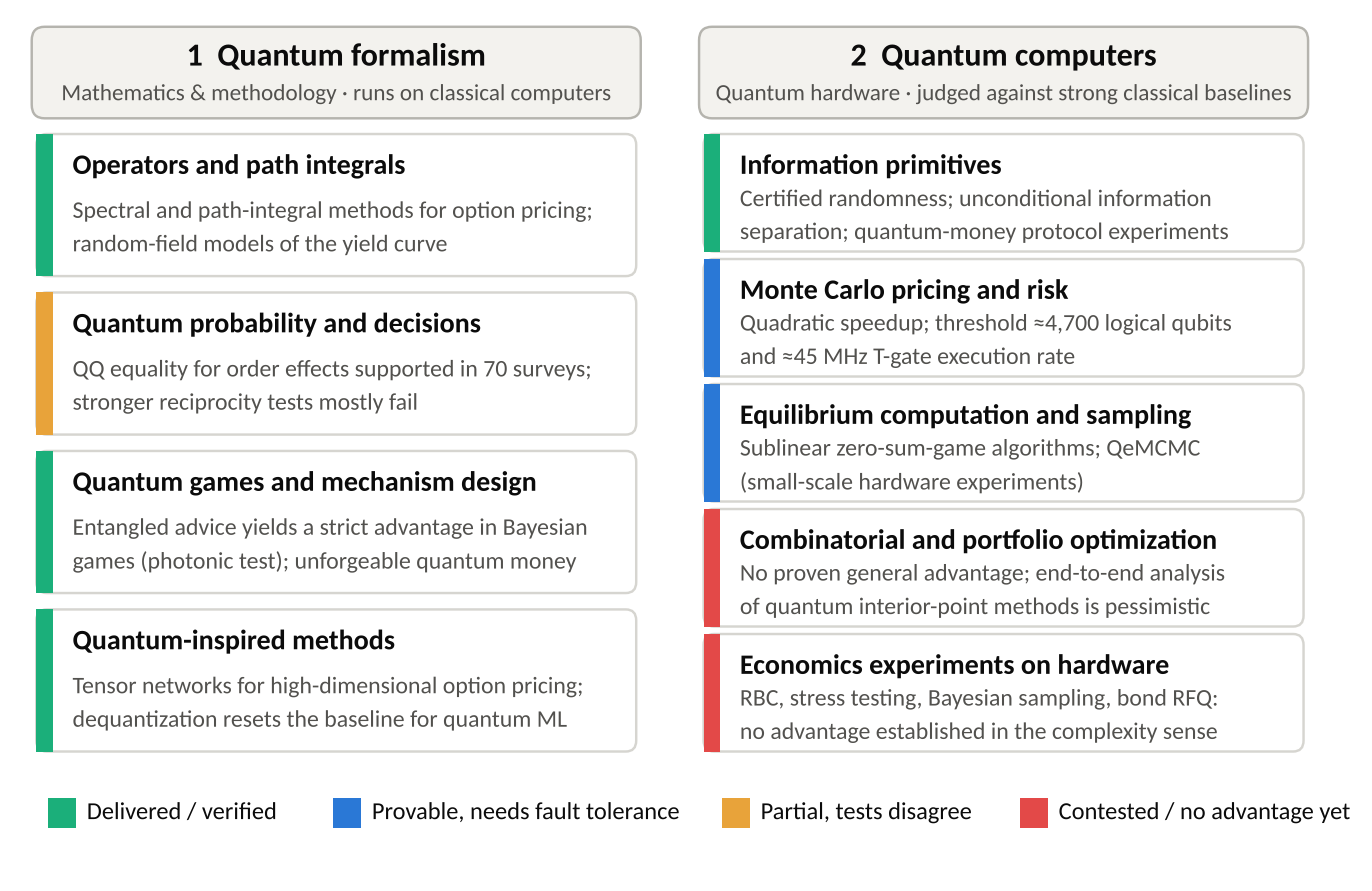
Quantum Formalism and Quantum Computing: What Can They Actually Solve in Economics and Finance?
This note distinguishes quantum formalism from quantum computation in economics and finance. It reviews mathematical methods and evidence for quantum advantage, separating information-resource advantages from computational speedups and assessing claims against classical baselines and end-to-end costs.
Quantum Logic Gates: Principles, Physical Implementations and Recent Progress
Quantum Computing Modalities: Principles, Recent Progress and Industry Landscape
Bitcoin Output Types and Address Formats: Evolution and Quantum Risk
Protocols, Identity and Payments: A Layered Evidence Review of Agentic Commerce
Human Authors, AI Verification, Open Challenge: The Editorial Model of Quantum Economics Notes
When text is no longer scarce
Generative AI has made text extremely cheap. QEN’s value lies not in producing more text, but in publishing, faster, research records that can be checked, cited, updated and held to account. What research publishing must protect is the outcome that claims can be tested and responsibility can be assigned.
What remains relatively scarce
Original evidence
New data, new measurements, new experiments or new derivations.
Verified claims
Whether a statement is supported by evidence, and to what extent.
Transparent sources
Whether readers can trace every number and every reference to a primary source at reasonable cost.
Accountable judgement
Who reached which conclusions and, when something is wrong, who is responsible and how it is corrected.
A durable research record
Whether content, revision history and corrections can be cited stably over the long term.
Who does what
QEN reallocates the roles in publishing. Review no longer depends on external referees: machine-verifiable integrity is assigned to the QENAI Agent, and novelty, importance and fit are judged by the editor.
| Role | Traditional journals | QEN |
|---|---|---|
| Authors | Humans | Humans and AI collaborate on research and writing; authors are responsible for all content |
| Review | External peer experts, volunteer and anonymous; finding referees takes time; references and numbers are usually not checked item by item as a matter of routine | The QENAI Agent verifies claims, references and numbers item by item and issues a verification report; no scores, no acceptance recommendation |
| Editor | Selects manuscripts, organizes review, decides | Judges whether the methods hold, whether the manuscript fits and how well it has been revised; decides on acceptance; handles post-publication comments; maintains versions |
| Readers | Can usually respond only by submitting a separate article, which is published apart from the original after a long delay and is easily missed by its readers | Challenges are published as comments numbered under the original article and linked from its page; comments follow the same fast process; the original authors may respond with a new version or a comment |
From submission to record
Submission
Word file, self-checked against the editorial article QEN202600
Editorial screening
Scope; significant new evidence or judgement
AI verification
Verification report and must-fix list
Response and revision
Authors respond to each comment
Editorial decision
Accept, revise and re-verify, or reject
Publication
QEN number, v1.0, archived on Zenodo
Comments and updates
Public comments; new versions cite the previous one
Questions
No. Under the definition widely used in publication ethics, peer review means obtaining advice from experts in the field who are not part of the editorial team. QEN’s process does not meet this definition, so the accurate description of a QEN article is “AI-verified and editor-approved”.
Yes. QEN does not restrict the use of AI tools and encourages authors to use AI for searching, analysis, programming, drafting and pre-submission self-checks. Authors disclose that use truthfully in the Author Statement and are responsible for all content, including AI-generated parts. AI cannot be an author, and AI-text detection results are not grounds for acceptance or rejection.
References, numbers and Key Claims, item by item: whether reference metadata match the source and the source supports the statement, whether numbers match their source or can be recomputed, and whether each claim is supported in the main text and worded no more strongly than the evidence. It also flags omissions, methodological concerns and hidden text. It issues a verification report with a must-fix list, gives no scores and makes no recommendation to accept or reject. It runs on locally deployed open-weight models; manuscripts are not sent to third-party AI services, and references are checked by retrieving the sources, not from model memory.
Submit a comment. Comments are numbered under the original article, for example QEN202601C1, are linked from its page and follow the same fast process as Research Notes. The original authors may respond with a new version or a comment of their own. QEN has no procedure for item-by-item corrections; a substantial challenge should be written up as a comment.
Yes. Authors may publish a new version, which must cite the previous version, with its DOI, and explain in the Author Statement and the version history what has changed and why. Every version is archived on Zenodo with its own DOI, and the website shows the latest version by default.
QEN is an institutional experiment that has not been shown to outperform traditional peer review. The editorial lists seven unresolved and new problems, among them the limits of AI verification, correlated errors between similar models, security risks of AI review and academic recognition.
Read Section 7 of the editorial →Submit a manuscript
Send a Word file to contact@quantecon.ai. QEN accepts Research Notes with significant original evidence, or a systematic synthesis of existing evidence, and Comments on published QEN articles. Incremental contributions are not accepted.
- Length
- No more than 3,000 words of main text
- Key Claims
- 3–5 for Research Notes; 1–3 for Comments
- Format and language
- Word (.docx); published in English
- Originality
- Unpublished and not under consideration elsewhere; preprints may be submitted
- After publication
- Publication in QEN is formal publication; the same content may not be submitted to another journal
- Fees
- None. Open access under CC BY 4.0; operating costs are borne by Quantum Economics AI Lab
Give the editorial to your own AI
Authors can give the full text of QEN202600 to their own AI and check a manuscript against Appendix A, item by item. A suggested prompt:
Review the following manuscript against QEN202600 (the Quantum Economics Notes editorial and its Appendix A, the submission guidelines). Check whether the manuscript structure is complete, whether the Key Claims meet the requirements, whether every reference and every number can be verified, and whether the Author Statement is complete, and go through the verification checklist in Appendix A item by item. When verifying references, actually open each source; if a source cannot be opened or verified, say so plainly and do not guess. For each comment, state its location, the type of problem, its severity (must fix / should fix / for information) and its basis. Begin the report with “Basis: QEN202600”. Check only claims, evidence and format; do not comment on writing style. Finish by listing all must-fix items.