Protocol Formation: A Functional Map of Agentic Commerce
Functional Roles, Governance, and an Authenticity Yardstick for A2A, AP2, x402, and ERC-8004
Quantum Economics AI Lab · quantecon.ai | Coverage of data and events through March 31, 2026 | v2.0 · revised August 2026
Abstract
By the end of Q1 2026, protocol implementations had emerged for all four core functions of agent-commerce infrastructure—though with markedly different levels of maturity and adoption: the A2A communication protocol entered vendor-neutral governance after its donation to the Linux Foundation; Google announced the AP2 authorization protocol with more than 60 payments and technology partners; the x402 settlement protocol, launched by Coinbase in May 2025, shipped its V2 upgrade and—together with Cloudflare—announced plans for an x402 Foundation; and the ERC-8004 identity standard officially launched on Ethereum mainnet on January 29, 2026. This report maps the landscape through four functional planes—interaction, authorization, settlement, and identity & reputation—emphasizing that these protocols are freely composable modules rather than a stack of forced dependencies, and introduces a layered authenticity framework—an L1–L3 economic-authenticity progression plus a cross-cutting autonomy-attribution dimension (L4)—as the common yardstick this series will use to interpret on-chain numbers.
Key Takeaways
- 01The four protocols answer four different questions (interaction / authorization / settlement / identity) and are complements without mandatory dependencies: AP2 is payment-rail agnostic, x402 runs on its own, and EIP-8004 explicitly states that payments are orthogonal to the proposal.
- 02Governance is neutralizing fast: A2A under the Linux Foundation, an x402 Foundation in formation, AP2 as an open specification, and ERC-8004 officially live on Ethereum mainnet within the quarter (its EIP-process text status remained marked Draft at the time of writing).
- 03On-chain numbers must be read in layers: protocol activity ≠ independent economic activity ≠ service delivery ≠ agent autonomy. This distinction is the methodological through-line of the series.
1 · Introduction: Four Functions, Not One Stack
When an AI agent attempts to complete a transaction on a user's behalf, four questions of different kinds must be answered. How does it find and talk to other agents or merchants (interaction)? How does it prove the user authorized this expenditure (authorization)? How does the money actually move (settlement)? And who is the counterparty, with what track record (identity and trust)? Industry commentary often lists A2A, AP2, x402, and ERC-8004 side by side or conflates them, but the four answer exactly one of these questions each—they are complements, not substitutes.
Just as important: they are composable modules, not a top-down dependency stack. A2A operates in settings with no payments at all; AP2 is payment-rail agnostic, supporting card networks and bank transfers as well as stablecoin settlement via an x402 extension; x402 does not require its counterparties to use AP2; and EIP-8004 states in its own text that payments are orthogonal to the proposal, offering only examples of how x402 payment proofs can enrich feedback signals [1]. Figure 1 therefore presents the landscape as a capability map rather than a technology stack.
![Figure 1 · The agentic-commerce capability map: four functional planes (as of Q1 2026). Author's synthesis based on official protocol documentation [1–4, 7].](/insights/q1-fig1.png)
2 · The Interaction Plane: A2A and Open Governance
The A2A (Agent2Agent) protocol was released by Google in April 2025 to enable discovery, capability negotiation, and task collaboration between otherwise opaque agent applications, with more than 50 technology partners at launch [7]; in June of the same year Google donated it to the Linux Foundation for vendor-neutral governance [8]. The rapid neutralization of the interaction plane was almost inevitable: inter-agent protocols carry extreme network effects, and control by any single vendor would suppress adoption.
3 · The Authorization Plane: AP2 and Verifiable Delegation
Existing payment infrastructure assumes a human is present at checkout—precisely the assumption agent transactions break. AP2 (Agent Payments Protocol), announced by Google on September 16, 2025 together with more than 60 partners including Mastercard, American Express, PayPal, Adyen, and Coinbase, rebuilds the chain of authorization cryptographically [3]: a user's request is recorded as an Intent Mandate; the cart assembled by the agent becomes, upon confirmation, a Cart Mandate; and the binding to a payment method forms the Payment Mandate. All three Mandates are tamper-proof signed digital contracts passed between parties as Verifiable Credentials, forming a tamper-evident, verifiable, and attributable audit trail that addresses authorization, authenticity, and accountability [3]. AP2's rail-agnosticism means the authorization and settlement planes compose freely—an illustration of modularity rather than stacking.
4 · The Settlement Plane: x402 and HTTP-Native Payments
x402 was launched by Coinbase on May 6, 2025, with AWS, Anthropic, Circle, and NEAR among its initial collaborators [2]. It turns the nearly three-decade-dormant HTTP 402 “Payment Required” status code into a machine-readable paywall: the server returns pricing and payment details in a 402 response, the client (typically an agent) signs a stablecoin payment authorization and resends the request, and a facilitator (the verification-and-settlement service) verifies the signature and settles on-chain [5]. The design removes account creation, API keys, and subscription relationships, making per-call, sub-cent machine-to-machine payments feasible. On September 23, 2025, Coinbase and Cloudflare announced plans to establish an x402 Foundation to safeguard the protocol's open governance and neutrality; x402 V2, released in December 2025, moved the protocol to a multi-chain-by-default architecture [4].
![Figure 2 · Standardization timeline through Q1 2026. Author's synthesis based on [1–4, 7, 8].](/insights/q1-fig2.png)
5 · The Identity & Reputation Plane: ERC-8004
ERC-8004 (Trustless Agents) is the Ethereum proposal for agent identity and trust, drafted by De Rossi, Crapis, Ellis, and Reppel and created on August 13, 2025 [1]. The proposal defines three lightweight registries: an ERC-721-based Identity Registry, a Reputation Registry, and a Validation Registry, with pluggable trust models ranging from reputation feedback to stake-secured re-execution, zkML proofs, and TEE attestations [1]. On January 29, 2026, the standard officially launched on Ethereum mainnet, and registrations accumulated quickly (this series' Q2 report presents the empirical measurements). One technical note: the mainnet launch and the EIP text's process status are separate tracks—as of this writing, EIP-8004 remains marked Draft on eips.ethereum.org. Notably, the proposal's own Security Considerations acknowledge that Sybil attacks can inflate reputation [1]; for a systematic comparison of the trust models implicit in A2A, AP2, and ERC-8004, see Hu and Rong's six-model study [6].
6 · Reading On-Chain Numbers: A Layered Authenticity Framework
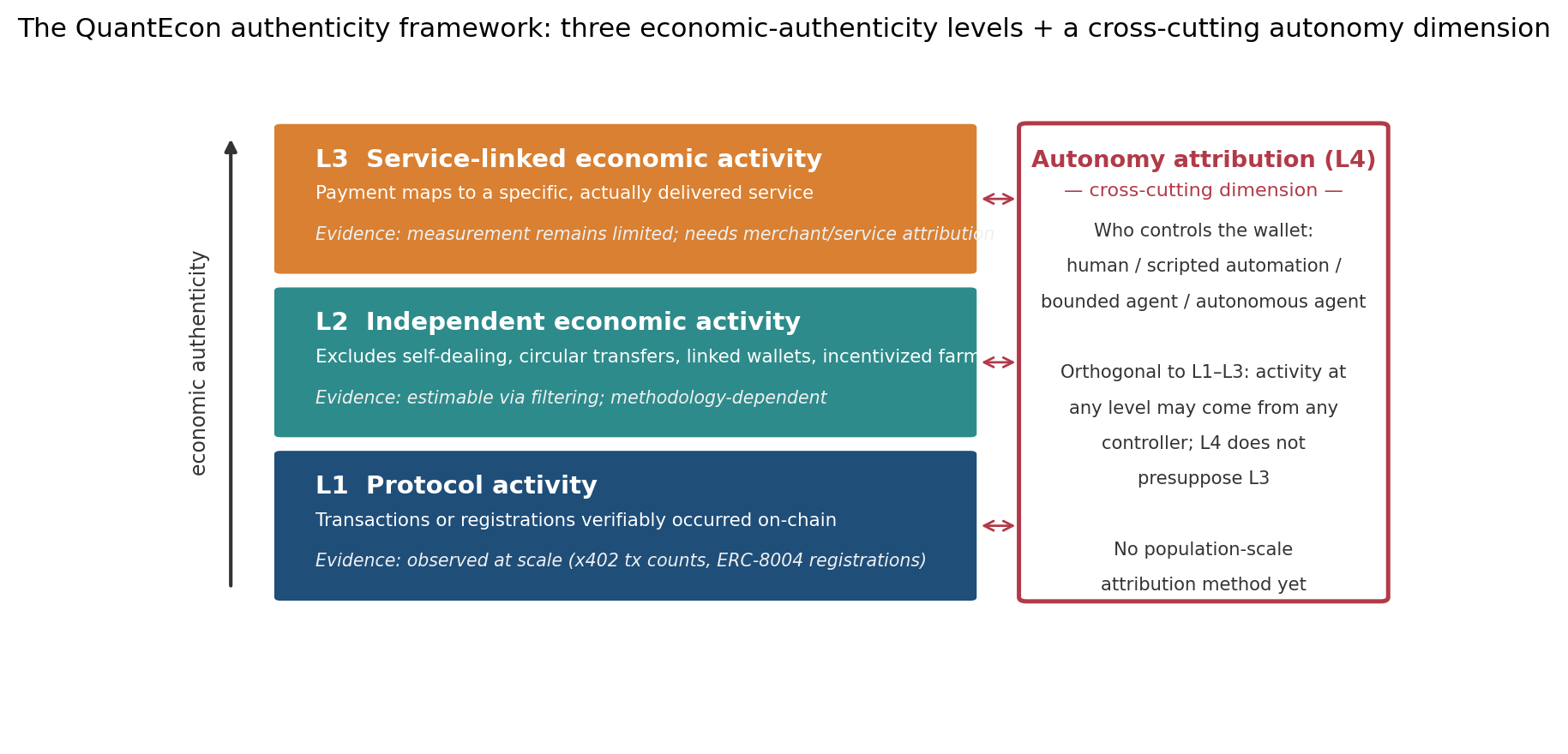
With the four planes in place, striking numbers began appearing on-chain—cumulative transaction counts, registered identities. To avoid conflating different kinds of evidence, we propose a layered authenticity framework that runs through this series. Levels L1–L3 form an economic-authenticity progression: L1, protocol activity (the events verifiably occurred on-chain); L2, independent economic activity (what remains after removing self-dealing, circular transfers, linked-wallet flows, and incentivized farming); and L3, service-linked economic activity (a payment maps to a specific service that was actually delivered). Each step up requires a different kind of evidence: L1 needs only chain records; L2 needs filtering methods, whose results are methodology-dependent; L3 needs merchant- and service-level attribution. L4, autonomous agent activity, is analytically distinct: it concerns who or what controls the wallet—a human, scripted automation, a bounded agent, or an autonomous agent—and cuts across L1–L3 rather than sitting above them. A human-operated wallet can reach L3, and an autonomous agent's payment may fail to yield service delivery; L4 should therefore not be read as presupposing L3, and no population-scale attribution method for it yet exists.
The framework also highlights two open problems in today's stack. First, payment and service delivery are not atomically bound in x402—there is no protocol-level guarantee that paying yields the service; Li et al. propose TEE-assisted Atomic Service Channels (A402) as one remedy [9]. Second, measurement infrastructure for L3 and L4 is still missing, and building it will be a central task for industry and academia over the next two years. The Q2 and Q3 reports in this series apply the framework to ERC-8004 identity data and x402 payment data respectively.
7 · Implications for Enterprises
Assess by plane, not by protocol allegiance. the interaction and authorization planes offer the basic protocol-level conditions for controlled pilots (enterprises should still evaluate implementation-level version stability, identity binding, security audits, and interoperability); in the settlement plane, facilitator security and concentration belong in any due-diligence checklist; the identity and reputation plane is newly launched with still-thin operational evidence—worth tracking, not yet worth depending on. And for any on-chain number a vendor or protocol team presents, use the layered framework to ask: which level does this number actually establish, and under what filtering methodology?
Data & methods notes
• This report covers protocol events through March 31, 2026; it is a synthesis, not an independent on-chain measurement.
• Evidence types are tagged in the references: protocol standards/documentation, protocol/company announcements, and arXiv preprints (not peer-reviewed).
• The layered authenticity framework is an analytical tool proposed by this lab, not an industry standard.
References
- [1] De Rossi, M., Crapis, D., Ellis, J., & Reppel, E. (2025). ERC-8004: Trustless Agents. Ethereum Improvement Proposal 8004, created August 13, 2025; officially launched on Ethereum mainnet January 29, 2026 (EIP-process status marked Draft as of August 2026). https://eips.ethereum.org/EIPS/eip-8004 [Ethereum standard / protocol documentation]
- [2] Coinbase (2025). Introducing x402: A New Standard for Internet-Native Payments. May 6, 2025. https://www.coinbase.com/developer-platform/discover/launches/x402 [Company announcement]
- [3] Google Cloud (2025). Announcing Agent Payments Protocol (AP2). Google Cloud Blog, September 16, 2025. [Company announcement]
- [4] x402 Project (2025). Introducing x402 V2: Evolving the Standard for Internet-native Payments. x402.org, December 11, 2025. https://x402.org/x402-v2-launch/ ; see also The Block, December 11, 2025. [Protocol documentation]
- [5] x402 Documentation. Core Concepts: Facilitator. https://docs.x402.org/core-concepts/facilitator [Protocol documentation]
- [6] Hu, B. A., & Rong, H. (2025). Inter-Agent Trust Models: A Comparative Study of Brief, Claim, Proof, Stake, Reputation and Constraint in Agentic Web Protocol Design—A2A, AP2, ERC-8004, and Beyond. arXiv:2511.03434. [arXiv preprint]
- [7] Google (2025). Announcing the Agent2Agent Protocol (A2A). Google for Developers Blog, April 2025. [Company announcement]
- [8] Linux Foundation (2025). Announcement of the Agent2Agent (A2A) protocol project, June 2025. [Press release]
- [9] Li, Y., Wang, L., Wang, K., Yang, Z., Wang, K., Guan, Z., & Gao, J. (2026). A402: Binding Cryptocurrency Payments to Service Execution for Agentic Commerce. arXiv:2603.01179. [arXiv preprint]