Quantum Formalism and Quantum Computing: What Can They Actually Solve in Economics and Finance?
Yulin Liu
Quantum Economics AI Lab
Mathematical methodology · Quantum computers · Classifying the evidence for quantum advantage (as of October 2026)
Key takeaways
|
1 Introduction: two kinds of “quantum”, four types of evidence
Discussions of what quantum technology can do for economics and finance often conflate two quite different things. The first is the quantum formalism: mathematical language drawn from quantum mechanics, such as Hilbert spaces, non-commuting operators, path integrals and tensor networks. These tools run perfectly well on classical computers; their value depends on whether they describe or compute economic phenomena better, and they are judged by empirical fit, testable predictions and computational efficiency. The second is the quantum computer: a physical device that exploits superposition, interference and entanglement. Its value depends on whether it can complete a task with resources no classical device can match, and it is judged by resource estimates and rigorous classical comparisons. The former belongs to modelling and methodology, the latter to computation and information, and the bar for evidence differs sharply between them.
This note is organized accordingly in two parts (Figure 1). For quantum computers, we further classify the evidence for “quantum advantage” into four types (Table 1). Type A is unconditional or information-theoretic advantage that relies on no unproven complexity assumption; Type B is computation that outperforms known classical algorithms under complexity assumptions; Type C comprises empirical claims on specific economic or financial problems; Type D comprises rigorously provable asymptotic speedups that can only be realized on fault-tolerant quantum computers not yet built. Types A and B differ in strength; Types C and D are two independent dimensions, the former concerning empirical performance on concrete tasks and the latter theoretical asymptotic complexity.
By practical quantum advantage we mean a reproducible advantage on an economically meaningful task, at equal accuracy or quality, relative to the current strong classical baseline, after accounting for end-to-end costs including data loading, state preparation, readout and error correction.
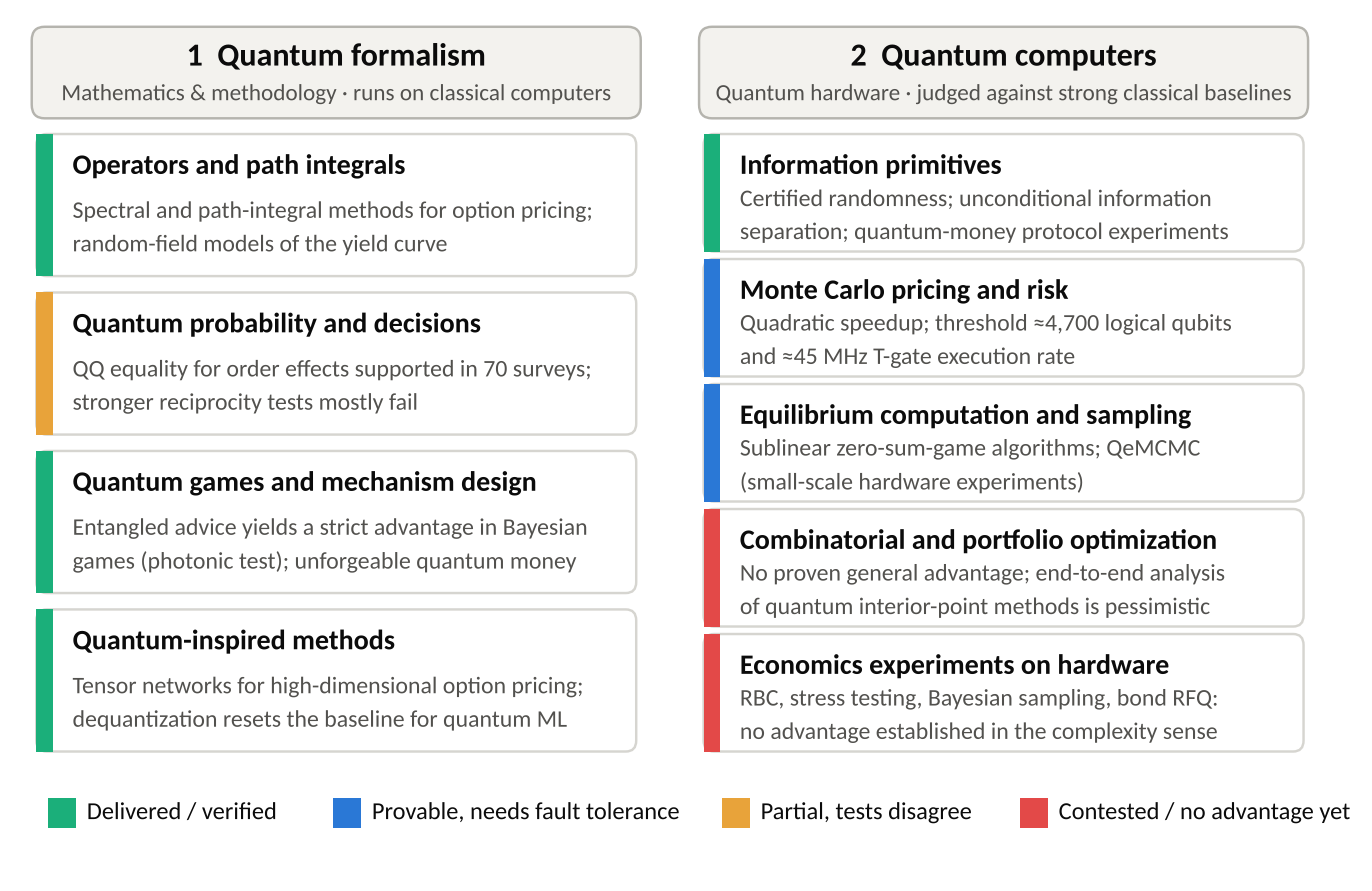
Figure 1 Framework of this note and the current state of evidence in each area. Colors indicate an overall assessment as of October 2026, not the conclusion of any single paper.
2 Quantum formalism: mathematics and methodology
2.1 Operators and path integrals: tools absorbed into the mainstream
After a change of variables, the Black–Scholes partial differential equation is isomorphic to the Schrödinger equation in imaginary time: an option price can be written as an evolution operator, generated by a “Hamiltonian”, acting on the payoff function. This correspondence brought physical tools such as spectral decomposition, path integrals and perturbation expansions into derivative pricing. Segal and Segal recast the Black–Scholes formula within quantum stochastic calculus, allowing certain market variables not to be simultaneously measurable with precision[1]. In interest-rate modelling, treating the entire forward-rate curve as a random field borrows the mathematics of field theory to capture imperfect correlation between shocks at different maturities, avoiding the degenerate correlation structure of finite-factor models[2].
Assessment. The contribution is real, but it consists of “borrowed mathematics” rather than the “discovery of quantum effects in markets”: the resulting models are classical stochastic processes that can be solved on classical computers and have become standard tools of financial mathematics. Calling them “quantum finance” invites misunderstanding; “physics-inspired computational methods” is more accurate.
2.2 Quantum probability and decision-making: descriptive success, contested tests
In standard classical (Kolmogorovian) probability models, intersections and unions within a single event algebra commute and the law of total probability holds; describing how the order of questions changes subsequent judgments usually requires introducing additional state updates or context variables. Many behavioral experiments reveal systematic patterns that simple classical models do not fit: the conjunction fallacy, the disjunction effect and choices that violate the sure-thing principle. Quantum probability represents such order dependence directly through non-commuting projections in Hilbert space, and uses a single set of axioms to explain several classes of judgment “errors”, including conjunction and disjunction fallacies[3], as well as the disjunction effect in prisoner's dilemma experiments[4].
The strongest evidence for this approach comes from question-order effects in surveys. Quantum models predict, before any data are examined, a constraint with no free parameters, the “quantum question (QQ) equality”: under the two question orders AB and BA, the total probability that the two questions receive the same answer should be equal; equivalently, the total probability of different answers should also be equal. Wang et al. tested this prediction using 70 nationally representative surveys (651–3,006 respondents each) and two laboratory experiments, and found strong support[5]. The evidence is not one-sided, however: a stronger “grand reciprocity” condition derived from the same quantum law is violated by non-degenerate quantum models in most existing data sets. Retaining a quantum description therefore requires moving to degenerate models with more parameters and weaker testability[6].
In economic theory, Lambert-Mogiliansky, Zamir and Zwirn proposed “type indeterminacy”: preferences do not exist determinately before they are elicited but are “actualized” at the moment of action, so the order in which questions are asked changes the distribution of an agent's types[7]. The idea has direct implications for mechanism design: if elicitation itself changes preferences, the classical assumption that agents truthfully reveal pre-existing preferences needs revision. Assessment: quantum probability is a compact descriptive language with distinctive, testable predictions about order and context effects, but it has not become a normative theory widely adopted in mainstream economics.
2.3 Quantum games and mechanism design: from “quantized games” to strict information-resource advantages
Early work on “quantum games” is exemplified by the model of Eisert, Wilkens and Lewenstein: once the strategy space of the prisoner's dilemma is extended to quantum operations, players can reach outcomes better than the classical Nash equilibrium[8]. Subsequent critiques showed that this result relies on an artificially restricted subset of quantum strategies; with the full strategy space, the apparent “escape from the dilemma” disappears[9]. Such work changes the rules of the game rather than demonstrating that quantum resources have value in themselves.
Rigorous results come from the correspondence between Bayesian games and Bell nonlocality. Brunner and Linden showed that the normal form of a Bayesian game can be recast as a Bell-test scenario: if players share entangled particles in advance as “advice”, they can implement joint strategies that no shared classical random variable (local classical correlation) can achieve, which leads to the notion of a quantum Nash equilibrium[10]. Pappa et al. then constructed the first conflicting-interest game in which quantum advice yields higher fair-equilibrium payoffs, and implemented it experimentally with entangled photons[11]. From an economic perspective, in this class of Bayesian games entanglement allows players to implement joint strategies beyond the set of correlations that any shared classical random variable can generate, while the no-signalling condition guarantees that these correlations cannot themselves be used to learn the other player's private type.
A separate line of work concerns quantum money. Wiesner proposed in 1983 to exploit the no-cloning property of quantum states to construct unforgeable money[12]; Bozzio et al. implemented, with weak coherent light, a “quantum credit card” protocol that rigorously satisfies the security condition for unforgeability, and derived working regimes that account for all practical imperfections[13]. For monetary theory, the most distinctive property of quantum money is that some protocols can provide, under an explicit threat model, information-theoretic unforgeability that classical information cannot achieve. Hull et al. further argue that one form of quantum money could combine the anonymity of cash, peer-to-peer transactions without a third party and the convenience of a debit card[14]; but anonymity, peer-to-peer payment and practical deployability depend on the specific protocol and remain constrained by hardware, notably long-lived quantum memory.
2.4 Quantum-inspired methods: currently the most deployable branch
Tensor networks were originally developed to compress quantum many-body states and rest on low-rank tensor decompositions. Glau, Kressner and Statti used the tensor-train format to represent Chebyshev interpolation coefficients in parametric option pricing, handling parameter spaces of up to 25 dimensions for American options under the Heston model and basket options under the multidimensional Black–Scholes model[15]. Such methods run on existing CPUs and GPUs and are among the most mature quantum-inspired branches with the clearest practical value.
Quantum inspiration also works in reverse, through dequantization. Tang showed that, under the same sampling-access assumptions as the quantum algorithm, the recommendation-system problem admits a classical algorithm that is only polynomially slower than the quantum one, removing the previously claimed exponential speedup[16]. Because financial data (return covariances, factor exposures) are often approximately low-rank, many claimed quantum machine-learning speedups for finance need to be re-evaluated against quantum-inspired classical algorithms.
2.5 Open problems the quantum formalism could address
- Context effects in survey and expectations data. Surveys of inflation expectations, risk preferences and consumer confidence are themselves “measurements”, and question order may systematically shift answers; parameter-free tests such as the QQ equality can serve as diagnostic tools for questionnaire design.
- Preference elicitation and dynamic mechanism design. If elicitation changes types, the optimal design of multi-round auctions, sequential voting and preference surveys must explicitly account for “measurement back-action”.
- Entanglement as a coordination and commitment device. Once quantum networks mature, the nonlocal advantage in Bayesian games could be turned into coordination, auction and voting mechanisms that need no trusted intermediary.
- Modelling the behavior of AI agents. Large language models are highly sensitive to question wording and option order, yet do not reliably reproduce human response biases[17]. Whether they exhibit order and framing effects that quantum probability models can characterize systematically is a directly testable question; the key is a head-to-head comparison with classical context models.
- High-dimensional pricing and heterogeneous-agent models. Tensor networks offer scalable tools for high-dimensional option pricing, risk aggregation and value-function approximation in heterogeneous-agent macroeconomic models.
3 Quantum computers: what has been done, what has been verified, what remains possible
3.1 Provable speedups and end-to-end resource estimates
Monte Carlo and derivative pricing. Under the corresponding state-preparation and oracle-access model, amplitude estimation reduces the query complexity required to reach error ε from O(1/ε2) to O(1/ε), a quadratic speedup[18]; Rebentrost et al. applied it systematically to derivative pricing[19]. This is the quantum algorithm with the firmest theoretical foundation in finance. Reviews generally regard it as the most promising application, while stressing that resource requirements must fall substantially before a real speedup becomes possible on early fault-tolerant machines[20].
What matters is the end-to-end resource estimate (Figure 2). Goldman Sachs and IBM's analysis of benchmark contracts such as autocallables found about 8,000 logical qubits and a T-depth of about 54 million, with execution required within about one second to constitute an advantage[21]; encoding payoffs directly into amplitudes with quantum signal processing reduced this to about 4,700 logical qubits, but still requires executing roughly 109 T gates at about 45 MHz[22]. More generally, given the large constant overheads of error correction, quadratic speedups are unlikely to pay off on early fault-tolerant machines; higher-order speedups are needed for confidence[23].
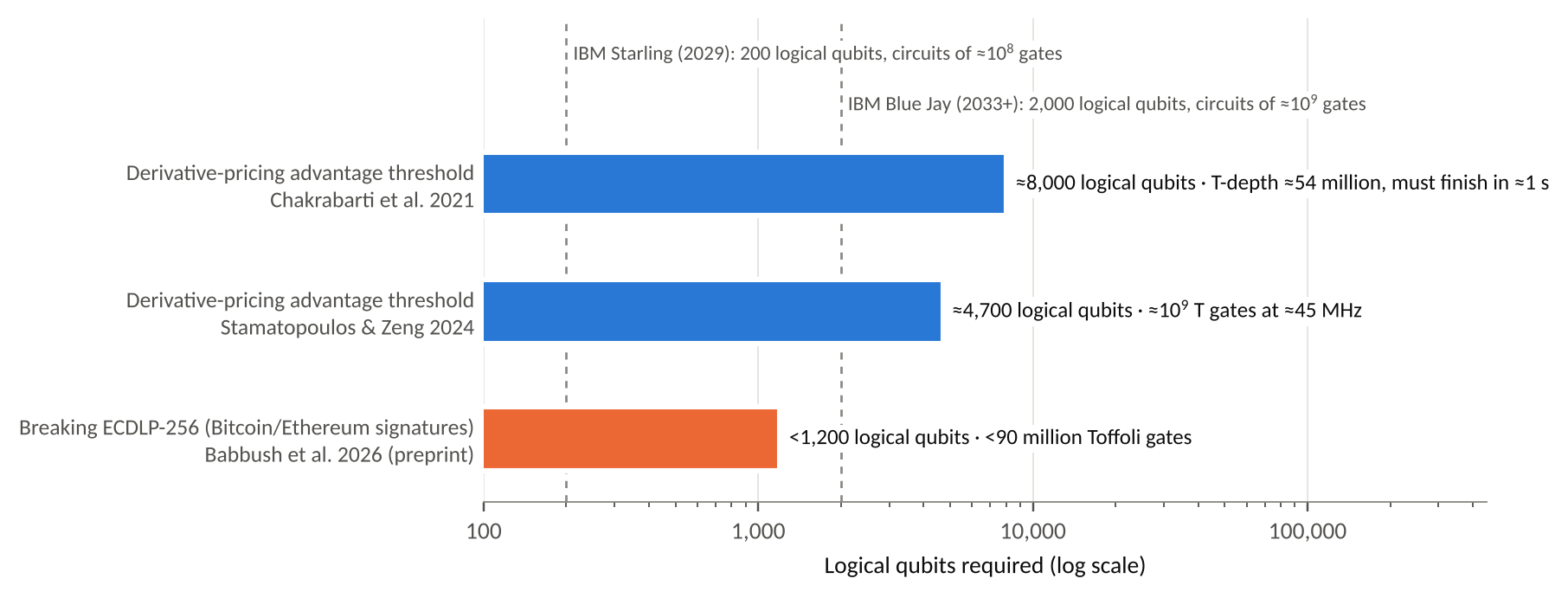
Figure 2 Logical qubits required by representative financial tasks compared with a hardware roadmap (log scale). Derivative-pricing thresholds are from [21,22]; the ECDLP-256 figure is a preprint estimate[24]; dashed lines mark the logical-qubit targets of Starling (2029) and Blue Jay (2033+) in IBM's public roadmap. Gate counts in the roadmap and T-gate counts in the pricing papers are not the same resource metric. The estimates differ in their gate-count and execution-rate requirements and indicate orders of magnitude only.
Optimization. Combinatorial optimization lacks proven general quantum speedups and recent work is mainly heuristic, so rigorous benchmarks and classical comparisons are essential[25]. In continuous optimization, a complete circuit-level analysis of the quantum interior-point methods used for portfolio optimization shows that, because of large constant factors, ill-conditioned linear systems and reliance on costly quantum state tomography, fundamental algorithmic improvements are needed for practical advantage even on small instances[26].
Equilibrium computation and sampling. For an m×n zero-sum game, in a model where the payoff matrix can be accessed through a standard quantum oracle, a known quantum algorithm finds an ε-approximate Nash equilibrium in time Õ(√(m+n)·ε−2.5 + ε−3), compared with Õ((m+n)·ε−2) classically: when the game is very large and the precision requirement moderate, the quantum algorithm has a sublinear advantage[27]. If the raw economic data must first be loaded classically in full, the end-to-end advantage may shrink or vanish. Quantum-enhanced Markov chain Monte Carlo (QeMCMC) for Boltzmann sampling of Ising models converged in fewer iterations than common classical MCMC in both simulations and experiments on superconducting hardware[28], offering a possible route for Bayesian estimation and for sampling in interacting market models; the authors note, however, that its convergence rate is difficult to establish theoretically and that whether it scales to larger sizes remains an empirical question.
3.2 Economic and financial experiments on real hardware
Macroeconomic dynamic programming. Fernández-Villaverde and Hull solve dynamic programming problems on a quantum annealer, using the real business cycle (RBC) model as a demonstration. The abstract of their 2023 NBER working paper (No. 31326) highlighted an order-of-magnitude speedup over benchmarks in the literature; the abstract of the version published in Quantitative Economics in 2026 instead emphasizes recovering value and policy functions, avoiding scaling bottlenecks and feasibility on current hardware[29]. The main text still reports an order-of-magnitude run-time advantage over selected classical benchmarks, with three qualifications: the benchmark is the run time of a C++ value-function-iteration implementation from the earlier literature, which the authors note falls to about one-third on a 2025 personal computer, narrowing the gap to roughly fourfold; the comparison excludes pre- and post-processing time; and the quantum solutions are less accurate than the classical ones. Because quantum annealing lacks a provable scaling advantage and the comparison is not an end-to-end benchmark against the strongest modern classical algorithms, the result is best viewed as empirical performance on finite instances rather than an established quantum advantage.
Stress testing and DSGE. A Bank of Canada team applied quantum Monte Carlo to bank stress testing with credit shocks and fire sales, and to a dynamic stochastic general equilibrium model solved with deep learning, providing circuit constructions and comparisons with classical Monte Carlo[30].
Bayesian inference. In a working paper, researchers at the BIS together with Uhlig and co-authors construct a quantum state whose measurement outcomes are samples from a discretized posterior distribution; the authors state explicitly that the method currently offers no computational speedup over MCMC[31].
Bond trading. HSBC and IBM used a Heron processor to apply nonlinear feature transformations to corporate-bond request-for-quote (RFQ) data and report, in a preprint, that models using hardware-transformed features improve out-of-sample scores by up to about 34% relative to models using the original data or transformations from noiseless quantum simulation[32]. Notably, the improvement appears only for quantum transformations that include hardware noise; noiseless quantum simulation produces no comparable gain. The result therefore cannot yet be attributed to quantum computation itself; establishing quantum specificity requires direct comparison with tuned classical random-feature, noise-injection and regularization baselines.
Summary. The value of these experiments lies in “translating” economic problems into quantum circuits and exposing engineering bottlenecks such as data loading and readout, not in demonstrating advantage. They show that economists can already run their own models on real hardware, but there is a long way to go before the results are “faster or better”.
3.3 Four types of evidence for quantum advantage
Table 1 classifies results relevant to economics and finance by type of evidence. The most counter-intuitive point is that the strongest unconditional evidence (Type A) currently concerns almost exclusively information resources rather than computational speedups. Kretschmer et al. used 12 qubits on Quantinuum's H1-1 to complete a task for which any classical method provably requires 62 to 382 bits of memory, a separation that relies on no complexity conjecture (preprint)[33]. Among Type B results, the one directly relevant to economics is certified randomness: JPMorgan, Quantinuum and collaborators generated random bits on the 56-qubit H2-1 and, verifying them with supercomputers sustaining about 1.1×10¹⁸ floating-point operations per second, certified 71,313 bits of entropy under a restricted adversary model and additional assumptions[34]. Auditable public randomness is exactly what lotteries, random selection, auction tie-breaking and blockchain validator selection require. It should be stressed that classical verification remains extremely costly in current experiments, so the near-term value lies first in demonstrating an information primitive that classical computation alone cannot provide, not in economic deployability. Other Type B results concern physics problems: Google's “Quantum Echoes” experiment provides a verifiable beyond-classical computation[35]. About two weeks after IBM's 2026 doped-Clifford sampling experiment appeared as a preprint[36], Manabe, Gu and Pan used a new tensor-network algorithm on 256 H100 GPUs to compute, in 37.3 minutes, exact amplitudes for the 2,051 output bitstrings IBM had published, with a largest intermediate tensor 256 times smaller than IBM's estimate[37]. This substantially weakens the classical-hardness argument for that finite instance but does not fully reproduce the device's sampling task; the more accurate conclusion is that IBM's claim has been narrowed rather than refuted. It also shows that Type B conclusions shift as classical algorithms improve.
Table 1 Types of evidence for quantum advantage relevant to economics and finance (as of October 2026)
Type | Definition | Representative results | Implications for economics and finance |
|---|---|---|---|
A | Unconditional or information-theoretic advantage; relies on no unproven complexity assumption | Strict advantage of entangled advice in Bayesian games, with a photonic experiment[10,11]; unconditional information separation of 12 qubits vs 62–382 bits (preprint)[33]; experimental realization of an unforgeable quantum-money protocol[13] | Coordination and commitment mechanisms without trusted intermediaries; unforgeable stores of value |
B | Outperforms known classical algorithms under complexity assumptions | Certified randomness (56 qubits, 71,313 bits of entropy)[34]; “Quantum Echoes” verifiable beyond-classical computation[35]; IBM verifiable sampling (preprint)[36]; for the classical response see [37] | Auditable public randomness (lotteries, random selection, validator selection); otherwise no direct economic relevance |
C | Empirical claims on specific economic or financial problems | Quantum annealing for the RBC model[29]; HSBC–IBM bond RFQ features (preprint)[32]; quantum Bayesian posterior sampling (working paper)[31] | Demonstrate feasibility and expose engineering bottlenecks; none establishes an advantage in the complexity-theoretic sense |
D | Rigorously provable asymptotic speedup; requires fault-tolerant machines | Quadratic Monte Carlo speedup[18]; resource thresholds for derivative pricing[21,22]; sublinear algorithms for zero-sum games (quantum oracle access required)[27] | Pricing, risk and equilibrium computation; thresholds of thousands of logical qubits and T-gate execution rates in the tens of MHz |
Note: types characterize the nature of the evidence, not its value for applications. Types A and B differ in strength; Types C and D are independent dimensions: the existence of an asymptotic speedup does not imply that empirical results on current hardware constitute an advantage, and vice versa. Type B conclusions shift as classical algorithms improve.
3.4 Problems quantum computers could still address
- Pricing, risk and XVA in the fault-tolerant era. Amplitude estimation and its extensions to value-at-risk and sensitivity calculations are the computational applications most likely to generate economic value first, but they require thousands of logical qubits and T-gate execution rates in the tens of MHz (Figure 2).
- Sampling problems. Bayesian estimation, pricing in combinatorial prediction markets and interacting market models are at heart problems of sampling from complex distributions. QeMCMC is a candidate particularly suited to near-term comparisons between hardware and classical baselines, but there is no evidence yet that its iteration advantage at limited scale will translate into an end-to-end computational advantage.
- Large-scale games and equilibrium computation. Sublinear quantum algorithms for zero-sum games, linear programming and correlated-equilibrium computation (given quantum oracle access and efficient data loading) may prove useful in very large strategy spaces, such as combinatorial auctions and network games.
- Verifiable public randomness. Certified randomness could serve as a “randomness public good” for lotteries, ordering and validator selection in blockchains and public procurement, although current classical verification costs are extremely high and it is not yet economically deployable; its trust model and costs call for analysis at the level of mechanism design.
- Cryptographic migration (the downside). The latest preprint estimate for breaking the 256-bit elliptic-curve discrete logarithm is fewer than 1,200 logical qubits and fewer than 90 million Toffoli gates, below the advantage threshold for derivative pricing[24]; moreover, an attack on an exposed public key can tolerate far longer run times than a pricing task, which must finish within seconds. For finance, the governance and coordination of post-quantum migration are more urgent than quantum speedups; a separate note in this series addresses the topic.
4 Conclusion: five questions for judging quantum claims
The quantum formalism already provides economics and finance with practical mathematical tools and testable behavioral models. Quantum computers have rigorously verified advantages in information primitives, but no established practical advantage in computational tasks such as pricing, optimization and forecasting. Faced with any claim about “quantum finance”, ask in turn:
- Formalism or machine? If it is only quantum mathematics, the result should be reproducible on a classical computer and judged by fit and prediction, not by speed.
- Which type of evidence? Unconditional separations, beyond-classical computation under complexity assumptions, empirical claims on specific problems and asymptotic speedups mean very different things.
- Is the classical baseline strong enough? Comparisons should include the best classical heuristics and quantum-inspired classical algorithms, not just naive Monte Carlo.
- Are end-to-end costs fully counted? Data loading, state preparation, readout and error-correction overheads often swallow asymptotic speedups.
- Does the value come from computation or from information? The most reliable economic value in the near to medium term may come from certified randomness, quantum-secure communication and post-quantum migration rather than from computational speedups.
Data and methods
|
References
[1] Segal, W. & Segal, I. E. The Black–Scholes pricing formula in the quantum context. Proc. Natl Acad. Sci. USA 95, 4072–4075 (1998).
[2] Goldstein, R. S. The term structure of interest rates as a random field. Rev. Financ. Stud. 13, 365–384 (2000).
[3] Busemeyer, J. R., Pothos, E. M., Franco, R. & Trueblood, J. S. A quantum theoretical explanation for probability judgment errors. Psychol. Rev. 118, 193–218 (2011).
[4] Pothos, E. M. & Busemeyer, J. R. A quantum probability explanation for violations of "rational" decision theory. Proc. R. Soc. B 276, 2171–2178 (2009).
[5] Wang, Z., Solloway, T., Shiffrin, R. M. & Busemeyer, J. R. Context effects produced by question orders reveal quantum nature of human judgments. Proc. Natl Acad. Sci. USA 111, 9431–9436 (2014).
[6] Boyer-Kassem, T., Duchêne, S. & Guerci, E. Testing quantum-like models of judgment for question order effect. Math. Soc. Sci. 80, 33–46 (2016).
[7] Lambert-Mogiliansky, A., Zamir, S. & Zwirn, H. Type indeterminacy: a model of the KT (Kahneman–Tversky)-man. J. Math. Psychol. 53, 349–361 (2009).
[8] Eisert, J., Wilkens, M. & Lewenstein, M. Quantum games and quantum strategies. Phys. Rev. Lett. 83, 3077–3080 (1999).
[9] Benjamin, S. C. & Hayden, P. M. Comment on "Quantum games and quantum strategies". Phys. Rev. Lett. 87, 069801 (2001).
[10] Brunner, N. & Linden, N. Connection between Bell nonlocality and Bayesian game theory. Nat. Commun. 4, 2057 (2013).
[11] Pappa, A., Kumar, N., Lawson, T., Santha, M., Zhang, S., Diamanti, E. & Kerenidis, I. Nonlocality and conflicting interest games. Phys. Rev. Lett. 114, 020401 (2015).
[12] Wiesner, S. Conjugate coding. ACM SIGACT News 15, 78–88 (1983).
[13] Bozzio, M., Orieux, A., Trigo Vidarte, L., Zaquine, I., Kerenidis, I. & Diamanti, E. Experimental investigation of practical unforgeable quantum money. npj Quantum Inf. 4, 5 (2018).
[14] Hull, I., Sattath, O., Diamanti, E. & Wendin, G. Quantum Technology for Economists. Contributions to Economics (Springer, Cham, 2024).
[15] Glau, K., Kressner, D. & Statti, F. Low-rank tensor approximation for Chebyshev interpolation in parametric option pricing. SIAM J. Financ. Math. 11, 897–927 (2020).
[16] Tang, E. A quantum-inspired classical algorithm for recommendation systems. In Proc. 51st Annual ACM SIGACT Symposium on Theory of Computing (STOC), 217–228 (2019).
[17] Tjuatja, L., Chen, V., Wu, T., Talwalkar, A. & Neubig, G. Do LLMs exhibit human-like response biases? A case study in survey design. Trans. Assoc. Comput. Linguist. 12, 1011–1026 (2024).
[18] Montanaro, A. Quantum speedup of Monte Carlo methods. Proc. R. Soc. A 471, 20150301 (2015).
[19] Rebentrost, P., Gupt, B. & Bromley, T. R. Quantum computational finance: Monte Carlo pricing of financial derivatives. Phys. Rev. A 98, 022321 (2018).
[20] Herman, D. et al. Quantum computing for finance. Nat. Rev. Phys. 5, 450–465 (2023).
[21] Chakrabarti, S., Krishnakumar, R., Mazzola, G., Stamatopoulos, N., Woerner, S. & Zeng, W. J. A threshold for quantum advantage in derivative pricing. Quantum 5, 463 (2021).
[22] Stamatopoulos, N. & Zeng, W. J. Derivative pricing using quantum signal processing. Quantum 8, 1322 (2024).
[23] Babbush, R. et al. Focus beyond quadratic speedups for error-corrected quantum advantage. PRX Quantum 2, 010103 (2021).
[24] Babbush, R. et al. Securing elliptic curve cryptocurrencies against quantum vulnerabilities: resource estimates and mitigations. arXiv:2603.28846 (2026).
[25] Abbas, A. et al. Challenges and opportunities in quantum optimization. Nat. Rev. Phys. 6, 718–735 (2024).
[26] Dalzell, A. M. et al. End-to-end resource analysis for quantum interior-point methods and portfolio optimization. PRX Quantum 4, 040325 (2023).
[27] Bouland, A., Getachew, Y., Jin, Y., Sidford, A. & Tian, K. Quantum speedups for zero-sum games via improved dynamic Gibbs sampling. In Proc. 40th International Conference on Machine Learning (ICML), PMLR 202, 2932–2952 (2023).
[28] Layden, D. et al. Quantum-enhanced Markov chain Monte Carlo. Nature 619, 282–287 (2023).
[29] Fernández-Villaverde, J. & Hull, I. Dynamic programming in economics on a quantum annealer. Quant. Econ. 17, 1–37 (2026).
[30] Skavysh, V., Priazhkina, S., Guala, D. & Bromley, T. R. Quantum Monte Carlo for economics: stress testing and macroeconomic deep learning. J. Econ. Dyn. Control 153, 104680 (2023).
[31] Frost, J., Madeira, C., Rastogi, Y. & Uhlig, H. Quantum Bayesian inference: an exploration. BIS Working Papers No. 1342 (Bank for International Settlements, 2026).
[32] Ciceri, A. et al. Enhanced fill probability estimates in institutional algorithmic bond trading using statistical learning algorithms with quantum computers. arXiv:2509.17715 (2025).
[33] Kretschmer, W. et al. Demonstrating an unconditional separation between quantum and classical information resources. arXiv:2509.07255 (2025).
[34] Liu, M. et al. Certified randomness using a trapped-ion quantum processor. Nature 640, 343–348 (2025).
[35] Google Quantum AI and Collaborators. Observation of constructive interference at the edge of quantum ergodicity. Nature 646, 825–830 (2025).
[36] Martiel, S. et al. Sampling hard circuits with verifiably high fidelity. arXiv:2607.25941 (2026).
[37] Manabe, H., Gu, H. & Pan, F. Classical simulation and design frontiers for IBM's doped Clifford sampling experiment. arXiv:2608.13110 (2026).
Cite this report
Liu, Y. (2026). Quantum Formalism and Quantum Computing: What Can They Actually Solve in Economics and Finance?. Quantum Economics AI Lab Research Note, October 2026. https://www.quantecon.ai/applied-research/quantum-formalism-economics-finance
BibTeX
@techreport{liu2026quantumformalismeconomicsfinance,
  author = {Liu, Yulin},
  title = {Quantum Formalism and Quantum Computing: What Can They Actually Solve in Economics and Finance?},
  institution = {Quantum Economics AI Lab},
  type = {Research Note},
  year = {2026},
  url = {https://www.quantecon.ai/applied-research/quantum-formalism-economics-finance}
}